
Resilient regional paths through industrial megaprojects
Mittelgeber: Haushaltsmittel
Laufzeit: 2026 - 2031
Leitung: Dr. Max Roessler
Bearbeitung: Dr. Max Roessler und Prof. Dr. Daniel Schiller
Resilient regional paths through industrial megaprojects: Different approaches in the semiconductor industry of Europe, Asia, and the US
Against a backdrop of increasing geopolitical tensions, shifting industrial policy strategies and growing uncertainty in global supply chains, the project examines the regional impact of industrial megaprojects (large-scale investments by multinational enterprises) in the (supra-)national strive for strategic autonomy. The analysis focuses on the semiconductor industry, a central target of recent policy initiatives aimed at reducing dependencies and strengthening technological sovereignty. Consequently, countries are shifting from distributed global supply chains toward more centralized, high-value investments.
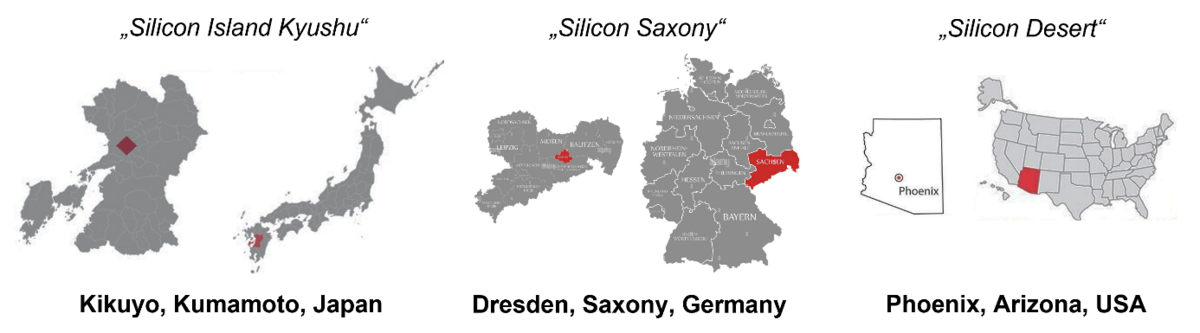
The research project comprises a comparative analysis of the United States', Japan's and Germany's respective industrial strategies and policy instruments (e.g. Chips Acts), examining how they shape spatial settlement patterns, clustering processes and comparing differences in regional semiconductor ecosystems. On the regional-level the case studies comprising subsidiaries of the Taiwan Semiconductor Manufacturing Company (TSMC) in Kumamoto (Japan), Saxony (Germany) and Arizona (USA). Despite differing political contexts, these second-tier regions face similar challenges related to infrastructure, labour availability, and the embeddedness of major foreign direct investment (FDI). The project explores how TSMC’s industrial ecosystem aligns with the different regional economies, with particular attention to technology transfer, supplier networks, skilled labour and resilience of regional industrial path development.
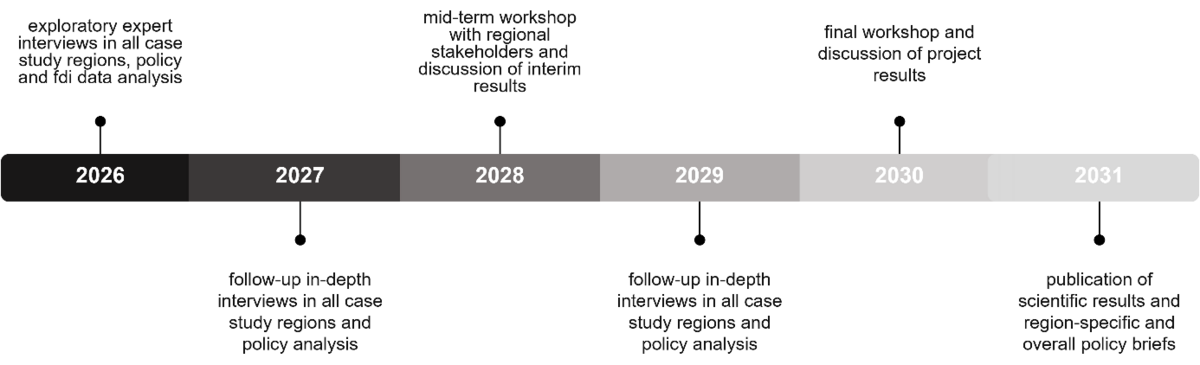
Methodologically, the project combines on-site expert interviews, industrial policy analysis, and FDI data analysis to investigate the co-evolution of multinational enterprises’ subsidiaries and regional innovation systems. It contributes to debates on the regional consequences of the shift from policies for dispersed industry settlements toward concentrated megaprojects, and by questioning whether such decoupling strategies enhance national and regional resilience in an increasingly fragmented global economy.

In addition to scientific findings, we want to facilitate exchange and networking between stakeholders in the case study regions, identify region-specific challenges and opportunities and develop expert-informed recommendations for action for comparable regions and future industrial megaprojects.
If you would like to learn more about the project, the latest developments, or potential opportunities for collaboration, please do get in touch. We look forward to hearing from you and connect.